



In mobility, “sharing” does not always mean the same thing. Sometimes it means using a car that is part of a fleet and that is passed from one user to another throughout the day. This is usually called a shared-use vehicle and, in practice, it is closely linked to carsharing.
This model has become especially established in urban environments because it allows people to access a car without needing to own one: you book it, use it and return it according to the availability and conditions of the service. It is a way to optimise vehicle use and reduce some of the fixed costs associated with ownership.
It is sometimes confused with “sharing a car with other people”, which is a different solution. If you want the full comparison, you can find it in our guide on the differences between carsharing and carpooling. Here, we are going to focus on the essentials: what a shared-use vehicle is, how it works and when it makes sense.
What is a shared-use vehicle?

A shared-use vehicle is a car available for different people to use at different times, usually through a platform or service managed by a company. Instead of assigning a vehicle to a single owner or fixed user, the car is used in “turns” and released for the next driver once the journey is complete.
That is why, when people talk about a shared-use vehicle, they are usually referring to carsharing: a mobility service where vehicle availability depends on an area, usage conditions and an access and payment system, almost always digital. The use does not necessarily have to be “shared” in the sense of travelling with someone else; what is shared is the resource over time.
How a shared-use vehicle or carsharing works
Carsharing is designed to be fast and autonomous. The user locates an available car within the service area, books it and unlocks it through an app or equivalent system. After the journey, the vehicle is returned according to the operator’s model, either to a specific point or within a defined area.
This logic fits occasional needs: a journey that is not well covered by public transport, a meeting outside the city centre, an errand or an occasional trip. In everyday use, the experience depends heavily on two factors: availability, meaning that there are cars when you need them, and coverage, meaning that the service operates in the areas that are relevant to you.
Common types of carsharing
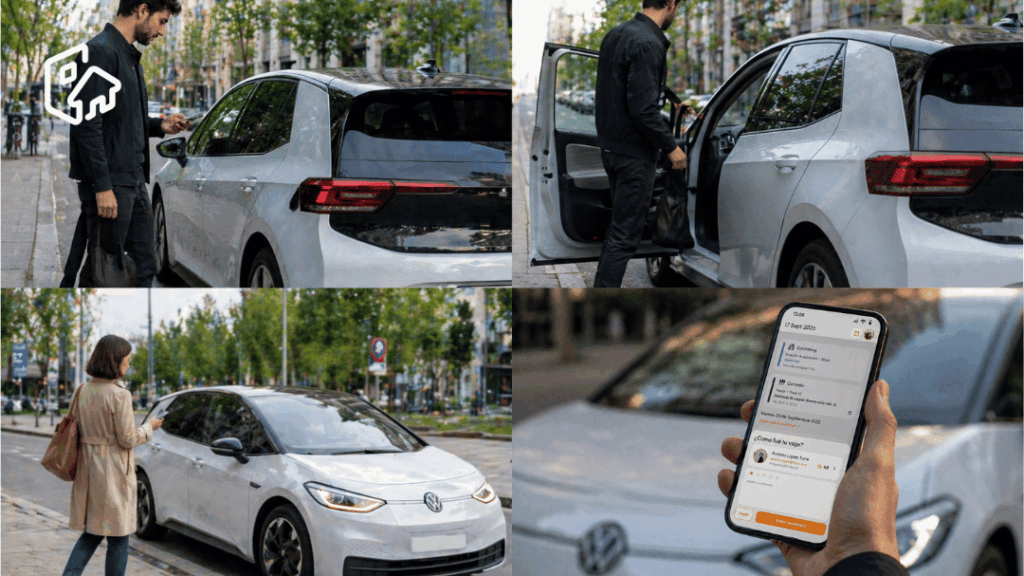
Although each provider has its own operations, there are usually two approaches. In some services, you can pick up and drop off the car within a specific area, which provides flexibility for urban journeys. In others, the car is picked up and returned at specific stations or bases, which is usually more predictable but limits where the journey can end.
To understand whether it is right for you, the important thing is to think about your routine: if your origin and destination are within the service area and you do not depend on “perfect” availability every morning, carsharing can be a real alternative to owning a car for certain profiles.
V-26 sign: what it means and when you will see it
In Spain, shared-use vehicles are often identified with a specific sign known as V-26. It is a visible sign placed on the vehicle that indicates it belongs to this shared mobility category.
In practice, the V-26 helps differentiate this type of car in contexts where urban mobility is regulated: parking, access areas or municipal initiatives that integrate carsharing services into their mobility strategy. It is important to be clear that it is not the same as an environmental label: the V-26 identifies the type of use of the vehicle, not its emissions level.
Does the V-26 provide parking or access benefits?
It depends on local regulations. There are municipalities where certain carsharing services operate under specific parking rules or in certain areas, but this is not universal or automatic. If carsharing is an important part of your mobility, the recommendation is always to check what conditions apply in your city and how they are defined for the specific service.
Types of carsharing: zone-based, station-based and corporate
To avoid surprises, it is worth understanding that “carsharing” is not a single format. In general terms, it can be organised by area or by stations, and there is also carsharing designed for companies.
Zone-based carsharing is usually the best known in cities, because it allows greater freedom to start and end journeys within a defined perimeter. Station-based carsharing tends to be more predictable, especially for planned journeys. And in the corporate environment, some organisations integrate shared vehicles for work-related needs: visits, meetings, travel between sites or occasional operational tasks.
In companies, the value appears when it does not make sense for a vehicle to be “assigned” to a single person, yet it is needed on a recurring basis. Sharing it internally can reduce costs and improve availability for the team, provided that usage is clearly managed.
Advantages and limitations of shared-use vehicles
Carsharing has an obvious advantage: accessing a car without ownership. This can reduce fixed costs such as maintenance, insurance, taxes or private parking, while providing flexibility of use. It also fits profiles that do not need a car every day or that combine several modes of transport and only require a car at specific times.
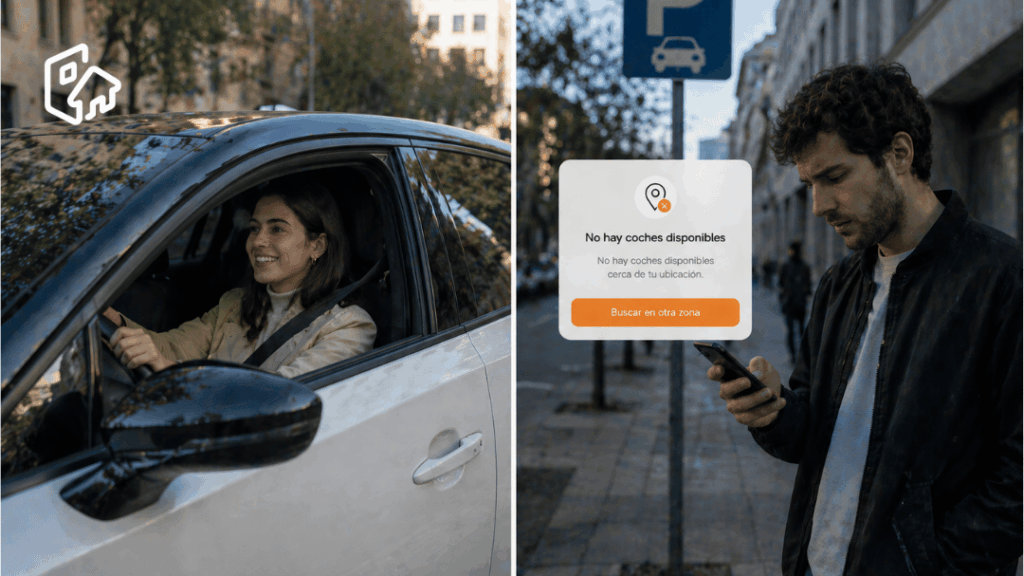
The other side is the model’s main limitation: you do not fully control availability. During peak hours or in high-demand areas, there may not be a vehicle nearby, or the time-based cost may become less competitive if usage becomes frequent. In addition, if your usual journeys fall outside the service area, carsharing loses value as a practical alternative.
In short, it makes sense when use is occasional and coverage is good; it becomes less efficient when you expect it to be your daily, rigid solution with no flexibility.
Not to be confused with carpooling to work
An important nuance is that a “shared-use vehicle” is not the same as “sharing a car with other people”. A shared-use vehicle is usually associated with carsharing, meaning a fleet shared in turns. Carpooling to work, on the other hand, is a solution based on sharing a journey with other people travelling to the same destination.
If you want to explore this in more detail, the best option is to read the specific article on the differences between carsharing and carpooling (internal link). For now, one practical idea is enough: carsharing is very useful for occasional mobility; for recurring commutes to work, many companies achieve better results by organising carpooling among employees, because it reduces single-occupancy cars without depending on external fleets.
Shared-use vehicles in companies: when they fit and what alternatives exist with Hybo
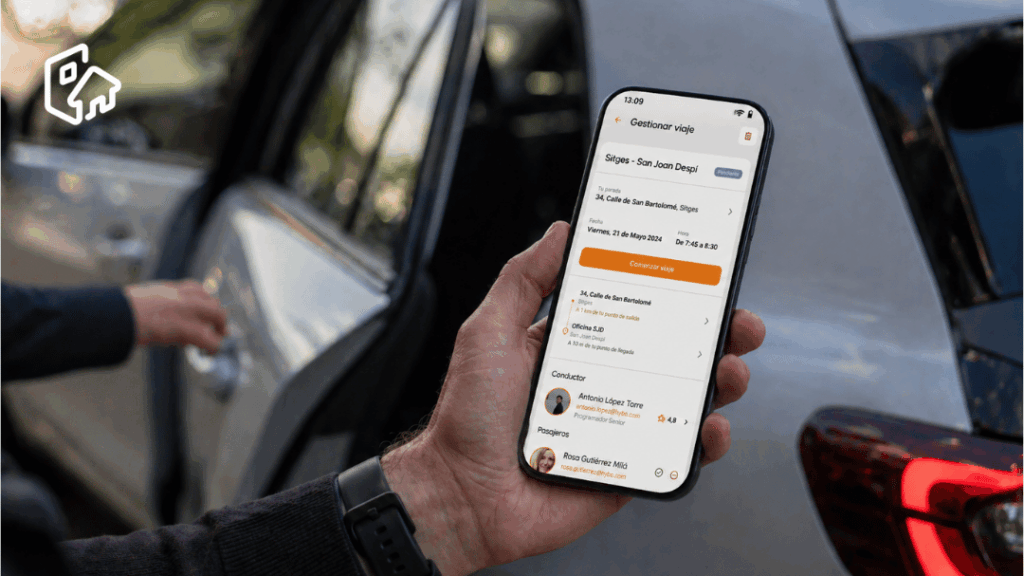
In the corporate context, a shared-use vehicle fits especially well when it is used as a work resource: journeys between sites, external meetings, commercial visits or occasional operational tasks. In these cases, sharing a vehicle can improve efficiency and reduce the number of cars assigned permanently.
However, when the challenge is commuting, meaning the daily journey to the workplace, the problem is usually different: too many cars arriving at the same time with only one person inside. In that case, the most direct alternative is usually corporate carpooling, because it acts on the pattern that generates congestion: single-occupancy car use.
At Hybo.app, the Carpooling module makes it possible to organise this carpooling within the company as a stable programme, preventing it from depending on informal coordination. This makes adoption easier and gives the company visibility to improve the initiative over time, site by site or shift by shift.
Frequently asked questions about shared-use vehicles
Are shared-use vehicles and carsharing the same?
In practice, yes. In common usage, “shared-use vehicle” usually refers to carsharing services: cars from a fleet that are used in turns, booked and paid for by time.
What does the V-26 sign mean?
The V-26 identifies shared-use vehicles. It is a sign indicating the type of use of the vehicle, not an environmental label. Its specific usefulness depends on municipal rules and the service in question.
Can carsharing be used to commute to work every day?
It can work in specific cases, but it is not usually the most suitable option as a rigid daily solution. Availability, coverage and time-based cost can work against you if you turn it into a daily routine with no flexibility.
What options do companies have to reduce single-occupancy cars?
In addition to measures such as flexible working hours or collective transport where applicable, many companies implement carpooling as a fast, high-impact measure. For it to work, it should be managed as a programme, with clear rules and monitoring.
How can a company organise carpooling without it becoming chaotic?
The key is to avoid scattered coordination and give structure to the programme. With the Hybo Carpooling module, carpooling is managed within a corporate environment, making adoption easier and helping sustain the initiative over time with more organised management.