


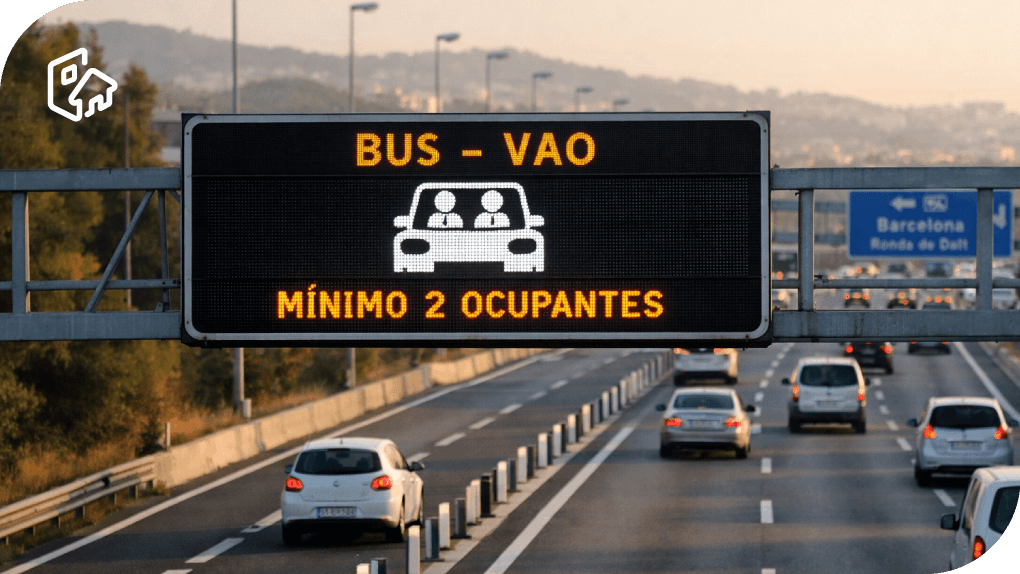
The HOV lane (High Occupancy Vehicle) exists for a very simple reason: to move more people with fewer cars, especially on access roads to large cities and corridors with heavy rush hour traffic. When it works well, it reduces congestion, improves the punctuality of public transport and rewards those who carpool instead of driving alone.
In 2026, the DGT (Directorate-General for Traffic) has also reinforced the ‘high occupancy’ approach in the regulation of these lanes: the priority is once again for the lane to fulfil its purpose (public transport and occupied cars), and access for cars with a single occupant — including those with environmental badges — is conditional on traffic conditions and variable signage.
In this context, carpooling is the natural ally of VAO: if the lane requires 2+ occupants and signage becomes stricter, organising shared journeys is no longer an ‘extra’ but a real operational advantage. With the Carpooling module from Hybo, carpooling is structured as a corporate programme (by centre/shift/route), is sustainable and can be measured.
What is a HOV lane?
A HOV lane is a lane reserved or prioritised for vehicles that meet certain conditions (usually a minimum number of occupants) and/or certain types of authorised vehicles. At many access points, it is combined with a BUS-VAO lane, which prioritises buses and high-occupancy vehicles and uses technology and signage to manage access dynamically.
The aim is not to ‘go faster for the sake of it’, but to reduce single-occupant car use, make road space more efficient and give priority to modes that move more people per vehicle (buses and car sharing).
What does HOV mean?
HOV stands for High Occupancy Vehicle. In practical terms, this usually means that the car must carry at least two people (including the driver), with exceptions depending on the section of road and signage.
What is the purpose of the VAO lane?
It serves to improve mobility during rush hour. The DGT explains that BUS-VAO lanes give priority to buses and high-occupancy vehicles in order to speed up the movement of people and encourage car sharing or public transport.
Who can use the VAO lane?
The most important rule in VAO is this: it is not enough to ‘know the general rule’; in many sections, fixed signage and, above all, variable signage (illuminated panels) take precedence, which can activate, restrict or expand access depending on traffic.
In general, access depends on three things: occupancy, type of vehicle, and signage on the stretch of road.
Which vehicles can use a VAO lane?
In general, vehicles that meet the minimum occupancy requirement (usually 2+, including the driver) can use these lanes, and, depending on the section, buses, motorcycles and other authorised vehicles may also use them. RACE summarises that, as a general rule, VAO lanes are for vehicles with at least two people (including the driver) and details the usual categories.
Exceptions and variable signage (BUS-VAO)
Here is the key point for 2026: the DGT indicates that passenger cars with environmental badges (CERO, ECO, B and C) can only access the BUS-VAO when indicated by roadside equipment, i.e. when signage allows it.
This explains why it is so important to look at the signs today: at certain times, the lane is opened or restricted to restore its efficiency during rush hour.
How many people are needed in the VAO lane?
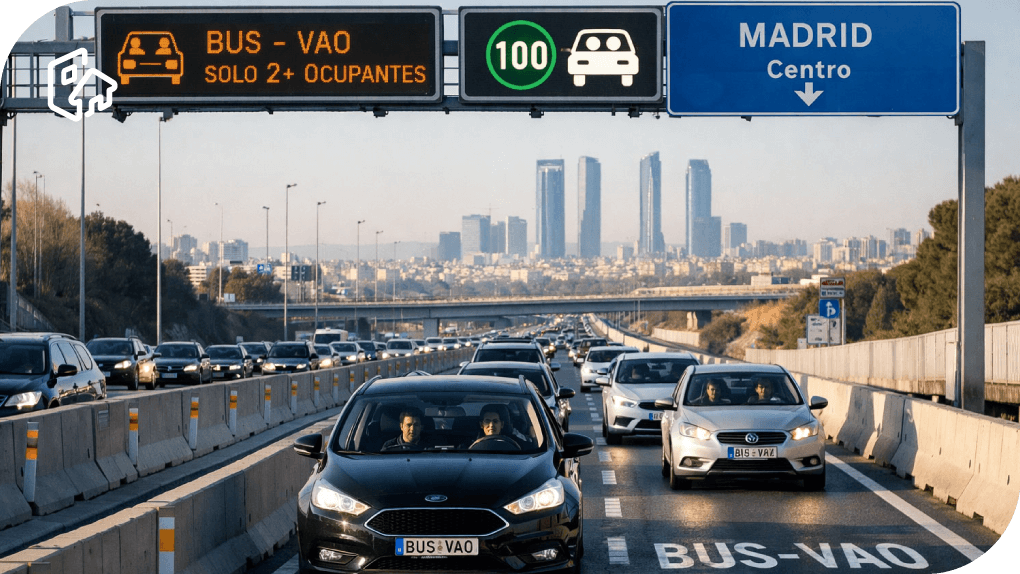
In Spain, the most common reference is two or more occupants (including the driver), although the exact requirement may vary depending on the road, time of day and signage. The DGT itself, in its resolution on special measures 2026, describes VAO lanes as those that allow driving when the minimum number is two occupants, including the driver, and prioritises this criterion over the type of propulsion.
How occupants are counted
In practice, people are counted, and the driver counts as an occupant. RACE expresses this literally for the general rule: ‘at least two people, including the driver’.
The important thing is that compliance is verified at checkpoints, and that some attempts to ‘simulate’ occupancy have resulted in penalties (so it is best to avoid shortcuts and organise real carpooling).
What happens in typical checks and penalties
Misuse is usually considered a serious offence and the typical fine mentioned in reference guides is €200, normally without loss of points in the case of driving without meeting access conditions. RACE includes this in its general explanation of penalties.
On BUS-VAO lanes such as those in Catalonia, the Catalan Traffic Service also indicates penalties of up to £200 for accessing them without meeting the requirements.
VAO lane rules: speed and signage

The speed in a VAO is not ‘free’: it is governed by the regulations for that section and the signage. In practice, what causes the most errors is not speed, but entering when it is not your turn (by not looking at the signs) or doing so with insufficient occupancy.
Signage is what counts. RACE insists that it is important to pay attention to signs and signals on the specific stretch of road because they determine who can drive at any given time.
Speed in VAO lanes
In SEO terms, the answer that ranks highest is straightforward: the speed is the same as that of the road and the signage for that section, and may vary if the lane is reversible, segregated or has specific regulations. In BUS-VAO, technological management and variable signage are also part of the operating system.
VAO and BUS-VAO lane signs
VAO lanes are usually marked with vertical signs, road markings and, in many urban access points, illuminated panels that activate or deactivate conditions. RACE describes the role of variable signage in activating/deactivating the lane, authorising/restricting access and U-turns in reversible lanes.
In BUS-VAO, the DGT highlights the integration of technology (beacons, access management, video surveillance and detection) to manage usage.
BUS-VAO lane: differences and specific rules
A BUS-VAO lane explicitly prioritises public transport and high occupancy. The DGT defines it as lanes reserved for buses and vehicles considered VAO, with the aim of speeding up the movement of people and prioritising car sharing or public transport.
Furthermore, in 2026, the message is clear: occupancy rules. The DGT explains that the use of VAO lanes by passenger cars with a single occupant, even those with a 0, ECO, C or B badge, is subject to signage and traffic conditions.
BUS-VAO A-6 (Madrid): how it works
The A-6 is the best-known case and one of those that has prompted recent adjustments. According to the DGT, the new resolution is based on data on congestion and traffic jams at rush hour on the A-6 BUS-VAO and seeks to return the lane to its intended purpose: public transport and high occupancy.
In practice, this means that it is always advisable to check the signs: access for vehicles with environmental badges may depend on what they indicate at that moment.
Recent changes and why carpooling is gaining relevance
Resolution 2026 prioritises high occupancy over propulsion mode and conditions access for single-occupant passenger cars (including ‘ZERO’ cars) to variable signage.
Industry media have summarised this as a practical tightening of the rules: to use BUS-VAO ‘in general’, 2+ occupants are required, unless the signs indicate otherwise in specific situations.
The result: if your goal is to take advantage of VAO on a daily basis, stable car sharing becomes the most solid strategy.
Where are there VAO lanes in Spain?
There is no single ‘map’ because some lanes depend on different administrations, but there are clear references.
Within the scope of the DGT, its BUS-VAO lanes page lists lanes in service such as the BUS-VAO A-6 (Madrid), the A-357/A-7056 (Málaga) branch and the V-21 (Valencia).
In addition, Resolution 2026 mentions corridors and actions at different points (e.g. A-6 and A-2 in Madrid, Granada, Seville, Málaga, Mallorca and Valencia), with activation conditional on fixed or variable signage.
In Catalonia, the Catalan Traffic Service details the BUS-VAO lanes on the C-58 (between Ripollet and Barcelona) and the C-31 north (Badalona), with specific conditions of use and permanent opening (24/7) for authorised vehicles.
How to take advantage of the VAO lane with carpooling in your company

If the VAO lane requires 2+ occupants and, in addition, vehicle access based on environmental labels may depend on panels, the business question changes: it is no longer ‘Can I enter today?’ but ‘How can I make it possible every day without improvising?’
This is where corporate carpooling is ideal: it turns repeated journeys (same location, same shifts, similar areas of origin) into carpools that meet occupancy requirements and allow consistent use of the VAO. And the more the priority of high occupancy is reinforced, the more sense it makes to organise it as a programme (rather than one-off agreements).
How to organise carpooling with Hybo to meet requirements
With Hybo you can structure carpooling by centre, shift and attendance routines, so that the match is realistic and repeatable. This reduces the main friction of carpooling: daily coordination. When the programme is stable, minimum occupancy ceases to be a concern and becomes a habit.
Furthermore, this way of organising it fits in very well with the public objective of VAO: to move more people per vehicle and reduce congestion. The DGT (Directorate-General for Traffic) clearly expresses this when it defines BUS-VAO as an alternative to prioritise carpooling and public transport.
Metrics to demonstrate results
In a HUB that aims to position itself, this block has to respond to what companies are looking for: ‘OK, how do I know it works?’ With carpooling, useful indicators tend to be adoption (repeat users), shared journeys and estimated number of cars avoided, as well as a very tangible piece of data: parking pressure and access during rush hour.
Frequently asked questions about VAO lanes
Is the VAO lane only for cars with two people?
The general rule is usually 2+ occupants (including the driver), but there may be exceptions depending on the section and signage. In 2026, the DGT will reinforce the priority given to high occupancy and will make access for cars with a single occupant (including those with environmental badges) subject to the indications on the signs and the traffic situation.
What is the fine for entering the VAO without complying?
Reference guides list this as a serious offence with a typical fine of €200 in many cases. RACE explicitly mentions this in its general explanation, and the Catalan Traffic Service indicates penalties of up to €200 on the BUS-VAO C-58/C-31.
Why is entry sometimes permitted with an environmental badge and sometimes not?
Because on many sections, variable signage may authorise or restrict access depending on traffic. The DGT explains that cars with badges can only access the BUS-VAO when indicated by roadside equipment, and resolution 2026 conditions use with a single occupant to illuminated signs and traffic conditions.
What BUS-VAO lanes are there in Spain?
Within the DGT’s jurisdiction, lanes in service are mentioned, such as the A-6 (Madrid), a branch in Malaga (A-357/A-7056) and the V-21 (Valencia). In Catalonia, the Catalan Traffic Service details the BUS-VAO lanes on the C-58 and C-31 north with specific conditions.
Why is carpooling ‘ideal’ for VAO?
Because VAO rewards occupancy. If you organise carpooling on a regular basis, you meet the minimum requirement and can take advantage of the lane during rush hour much more consistently, especially with the reinforcement of priority for high-occupancy vehicles that the DGT will implement in 2026.